


Life happens—illness, a work trip, a school exam, a car that won’t start. The good news: USCIS lets you reschedule a biometrics appointment if you do it before your original time and you have good cause. In many cases, you can now handle it online through your USCIS account in a few clicks.
This article shows you exactly how to postpone (reschedule) without hurting your case. You’ll learn what good cause looks like (with real-world examples), how to submit a request that gets approved, when to ask for accommodations or mobile biometrics for medical needs, and what to do if you already missed the appointment. We’ll also cover how rescheduling can affect downstream milestones like work permits and change-of-status timelines—and point you to plain-English form guides if you’re juggling filings like I-539 or I-765. For deeper help on those forms, see Immiva’s I-539 complete guide and H-4 EAD tips.
Postponing vs. skipping: what USCIS expects
Don’t skip. USCIS expects you to request rescheduling before the appointment and to show good cause. If you simply don’t show up and don’t act fast to fix it, your application can be treated as abandoned, which risks denial.
What counts as “good cause”? USCIS guidance focuses on whether your reason is reasonable and outside your control. Common examples include illness, family emergency, transportation breakdown, unavoidable work or travel, or extreme weather/closure at the ASC. Officers look at timeliness and supporting proof when deciding.
Timing matters. A timely request (before your slot) is treated much more favorably than a last-minute or post-hoc explanation. If you’re reading this the morning of your appointment and can’t make it, submit the online request immediately; if online isn’t available for your case, contact the USCIS Contact Center.
The fastest path: reschedule online (myUSCIS)
USCIS launched online rescheduling in 2023. If your case is eligible, you’ll see a “Reschedule Biometrics” option in your account; follow the prompts to pick a new date/time (and, in some scenarios, a different ASC location, subject to availability).
Step-by-step:

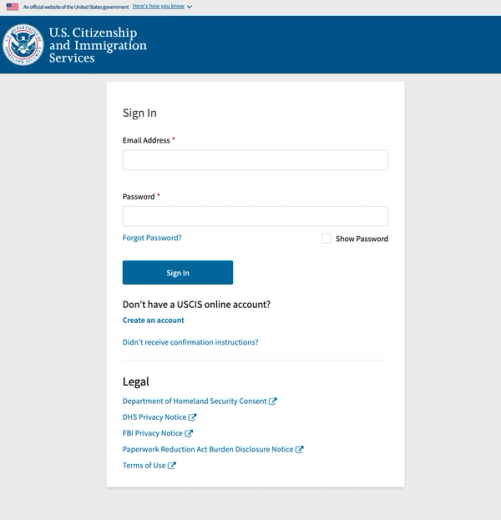
- Sign in to your myUSCIS account (create one if you haven’t).
- Open your case and choose Reschedule Biometrics (if shown).
- Select a reason (good cause) and upload any supporting documents—for example, a doctor’s note or non-refundable travel itinerary.
- Pick a new slot; confirm and save the new notice when it becomes available.
- Calendar it and arrange transportation in advance.
Changing location
Official USCIS messaging highlights rescheduling; some reputable law-firm guidance indicates the online tool can also allow changing the ASC when slots exist. Availability varies by region, so treat a location change as possible but not guaranteed.
How to write a solid reschedule request
Keep it short, factual, and specific. A good request gives a clear reason, the date/time you can’t attend, the new window you prefer, and any proof. USCIS’s good-cause framework doesn’t demand magic words—just credible circumstances and timely action.
Template:
Subject: Request to Reschedule Biometrics Appointment – [[Your Full Name]], [[Receipt #]], [[A-Number]]
I request to reschedule my biometrics appointment currently set for [[Day, Month DD, YYYY]] at [[Time]] at the [[ASC City, State]] ASC.
Reason (good cause): [[very brief reason – e.g., influenza confirmed by my doctor / pre-paid international travel booked before the notice / employer-mandated training / child-care emergency / severe transit disruption / extreme weather warning]].
I have attached supporting proof: [[doctor’s note / itinerary / employer letter / transit or weather notice]].
I can attend any date on/after [[Month DD, YYYY]] and prefer [[mornings/afternoons]] at [[ASC City, State]] if available.
Thank you for your consideration.
Applicant: [[Full Name]]
DOB: [[MM/DD/YYYY]]
Receipt #: [[SRC/WAC/LIN/IOE…########]]
A-Number: [[A#########]]
Phone: [[###-###-####]]
What to attach:
- Illness: brief doctor’s note confirming inability to attend on the date.
- Family emergency: hospital discharge summary, funeral notice, etc.
- Work conflict: employer letter noting the conflict and impossibility to attend at that time.
- Travel: non-refundable itinerary pre-booked before notice arrived.
- Transit/weather: local closure or service alerts.
Families and dependents: If multiple family members received different dates, ask whether the ASC can see you on the same day. Some centers accommodate families when capacity allows (it’s a courtesy, not a right). If coordinating is critical, reschedule all notices to a single day as soon as slots appear.
Special cases: medical needs, mobility issues, and mobile biometrics
If you cannot travel to an ASC because of a disability or serious health condition, ask USCIS for disability accommodations. Options can include extra time, wheelchair access, interpreter support, or modified procedures. USCIS outlines the accommodation process on its public guidance pages.
In limited circumstances, USCIS can provide mobile biometrics—they come to you (for example, at a hospital)—when a medical condition truly prevents travel to the ASC. This is not a convenience service; it’s tied to documented need, and you should request it as early as possible.
How to ask:
- Submit an accommodations request referencing your A-Number, case receipt, scheduled date/time, and what you need. Include a doctor’s letter that explains why travel to the ASC is not possible and for how long.
- If you also need to reschedule, do both: request accommodations and submit the reschedule (online or via Contact Center, as applicable).
Kids and elderly applicants: If fingerprints are hard to capture (tiny hands, worn ridges), ASCs have procedures to try multiple scans. Bring IDs for everyone with appointments and build in extra time. (This supports smooth capture when you do attend.)
If your ASC is closed: USCIS posts closure info; in that situation, USCIS will reschedule—you won’t be penalized for a closure.
If you already missed it: damage control and next steps
Act immediately. If you’ve missed your slot, contact USCIS right away (online account or Contact Center). Explain the reason and ask for a new appointment. Delays raise the risk your case gets tagged as abandoned. Consumer legal sources warn that abandoned cases may require refiling (and new fees) if USCIS won’t reopen.
Watch for a new notice. If USCIS grants another slot, you’ll receive a fresh I-797C. Put it on the calendar, plan your commute, and arrive early.
Status tracking. After a successful reschedule and capture, many applicants see “Biometrics Completed” in their online status within days or weeks (timelines vary). If your end goal is an EAD, this is often the checkpoint that lets adjudication proceed. For monitoring tips, see 5 Ways to Check EAD Status.
Will rescheduling delay my whole case? Possibly, by the amount of time you push the appointment out—and longer if your ASC is busy. That said, a clean reschedule with good cause is far better than a no-show.
Quick Takeaways
- Postpone the right way: request rescheduling before your slot and show good cause.
- Use the online tool in your myUSCIS account when available; otherwise call the Contact Center (no mail/in-person reschedules).
- Attach proof (doctor’s note, itinerary, employer letter) and keep your explanation brief and specific.
- Medical barriers? Ask for disability accommodations or, in limited cases, mobile biometrics.
- Missed it already? Act immediately to reduce abandonment risk.
Conclusion
If you need to postpone your USCIS biometrics, do it the official way: ask before your appointment, give a good-cause reason, and—if available—use the online rescheduling tool in your USCIS account. That simple, timely step protects your case from the very real risk of abandonment that comes with a no-show. For medical barriers, lean on disability accommodations or, where justified, mobile biometrics.
If your biometrics is tied to filings like I-539 or an EAD, keep the paperwork clean and the timelines aligned—small inconsistencies can snowball into extra appointments. For practical, plain-English help, start with Fill Out Form I-539 in 2025: Your Complete Guide, Form I-539 for H-4: What You Really Need to Know, and H-4 EAD application mistakes. If you’re filing for a spouse/child on J-2, see How to Apply for J-2 Visa EAD. These resources keep your forms tight so your rescheduled biometrics is the only change you’re making.