
Your spouse's immigration status doesn't block the I-130 petition, but the path to a green card usually depends first on how they entered the country and whether any exception, such as INA § 245(i) or another special provision, applies.
If you're a U.S. citizen married to someone without legal status, the first question is usually: can I even file an I-130? Yes. A U.S. citizen can file an I-130 petition for an undocumented spouse. But the I-130 only proves the family relationship. It doesn't grant a green card, and it doesn't protect your spouse from removal. Those are two very different things, and in 2026's enforcement climate, the gap between them is wider than it used to be. If you don't understand the unlawful presence bars and waiver options before you file, you could end up with an approved petition and a spouse stuck outside the country for years.
How your spouse entered the U.S. changes everything
This one question determines your entire case. The answer puts you on one of two very different tracks.
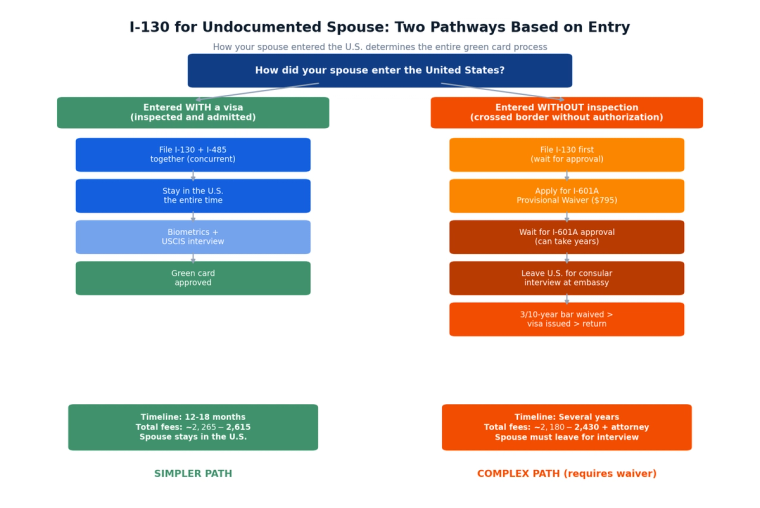
If your spouse entered with a visa but overstayed, they were "inspected and admitted" under INA § 245(a). Good news: they can file the I-130 and I-485 (adjustment of status) together and stay in the U.S. the whole time. No consular interview abroad, no departure. As of mid-2026, expect roughly 8 to 10 months for immediate relatives of U.S. citizens. Your spouse will go to a biometrics appointment and a USCIS interview, but everything happens domestically.
If your spouse entered without inspection (crossed the border without authorization), they generally cannot adjust status inside the U.S. under INA § 245(a). In many cases, the case proceeds through consular processing abroad, unless the person qualifies for an exception such as INA § 245(i) or another specific form of relief.
The unlawful presence bars and the I-601A provisional waiver
If your spouse is on the consular processing track, this next part matters a lot. When an undocumented spouse who entered without inspection leaves the U.S. for their consular interview, the departure itself triggers the unlawful presence bars under INA § 212(a)(9)(B):
- 3-year bar: 180 days to less than 1 year of unlawful presence, then departure
- 10-year bar: 1 year or more of unlawful presence, then departure
Most undocumented spouses have well over a year of unlawful presence, which means the 10-year bar. Without a waiver, your spouse leaves for their interview and can't come back for a decade.
The I-601A provisional waiver exists for exactly this situation. It lets your spouse apply for forgiveness of the unlawful presence bar before leaving the country (8 CFR § 212.7(e)). Get the I-601A approved first, then leave for the interview knowing the bar has been waived.
I-601A eligibility requirements:
- An approved I-130 petition
- Physical presence in the U.S. at time of filing
- Inadmissible only for unlawful presence (no criminal inadmissibility)
- Proof of extreme hardship to a U.S. citizen or LPR spouse or parent
- Not in removal proceedings, unless the proceedings are administratively closed and have not been recalendared at the time of filing
The filing fee is $795. See our guide on how to pay USCIS filing fees. Form I-601A is not currently available for online filing, and USCIS does not list it as a fee-waiver-eligible form. Waiver processing is slow: USCIS's latest published figures show 80% of I-601A cases completed within about 43.5 months, so plan on the waiver stage alone taking around three and a half years.
What the 2025-2026 enforcement changes mean for your case
Filing an I-130 for an undocumented spouse got riskier in 2025. Several things changed at once:
USCIS Policy Alert PA-2025-12, effective August 1, 2025, updated family-based petition guidance. USCIS may deny an I-130 without first issuing an RFE or NOID when there is no legal basis for approval and no additional evidence could cure the defect. The guidance also clarifies that USCIS may issue a Notice to Appear if the alien beneficiary is otherwise removable, because a family-based petition does not grant lawful status or relief from removal.
Beginning in late 2025, media reports documented ICE arrests at some marriage-based green card interviews, particularly in San Diego. Separately, Presidential Proclamation 10949 (effective June 9, 2025) suspended or limited visa issuance for nationals of 19 countries, and Presidential Proclamation 10998 (effective January 1, 2026) expanded the list to roughly 39. Both are covered in our breakdown of the 2025 travel ban. USCIS had also put pending benefit applications, including adjustment of status, on hold for nationals of the expanded list, until a federal court struck those holds down on June 5, 2026. The government is expected to appeal. None of this is a blanket freeze for everyone else: each proclamation carries country lists and stated exceptions, so check whether your spouse's country is actually covered.
The Keeping Families Together parole-in-place process was vacated by a federal court on November 7, 2024, and USCIS stopped adjudicating new or pending Form I-131F requests. DHS had estimated that about 500,000 noncitizen spouses of U.S. citizens could be eligible. Even without that program, many spouses who entered without inspection still pursue the I-130 → I-601A → consular processing route, but it is not the only possible pathway because some people may qualify for exceptions such as INA § 245(i) or other relief.
With all of that said, an I-130 petition is still the starting point for most marriage-based green card cases. USCIS continues to face significant pending caseloads and processing delays, with more than 11 million pending family petitions in the queue. Getting an attorney involved is worth it in this environment.
Total cost and timeline
For spouses who entered legally (adjustment of status):
- I-130 filing: $625 online / $675 paper
- I-485 filing: $1,440
- Medical exam: $200-$500
- Total filing fees: roughly $2,265-$2,615
- Timeline: roughly 8-10 months
For spouses who entered without inspection (consular processing with I-601A):
- I-130 filing: $625-$675
- I-601A waiver: $795
- DS-260 immigrant visa: $325
- USCIS immigrant fee: $235
- Medical exam: $200-$500
- Total filing fees: roughly $2,180-$2,430
- Timeline: often several years; the I-601A waiver stage alone is currently averaging around 43 months per USCIS's latest published figures.
Attorney fees for the full consular processing route run anywhere from $3,000 to $10,000+. Check the current Visa Bulletin for processing updates. Be aware that the State Department has paused immigrant visa processing for 75 countries, which could affect your timeline. Your spouse's Alien Registration Number (A-Number) gets assigned during the process and is needed for all future immigration filings.