

Reported USCIS processing times rose in 14 of the 17 form categories reviewed between FY2025 Q1 and FY2026 Q3, though the size of the increase varied. N-400 naturalization rose from 5.5 to 9.5 months, while the other-relative I-130 category rose from 33.6 to 43.3 months.
Three categories had shorter processing times. Immediate-relative I-130 fell from 14.3 to 13.0 months. Family-based I-485 fell from 9.4 to 7.0 months, and employment-based I-485 fell from 6.9 to 6.0 months. Even so, net backlog grew as a share of pending cases in all three.
This analysis uses seven USCIS quarterly service-wide forms reports and the matching net-backlog reports, covering October 2024 through June 2026. Quarterly data includes more decisions than a single monthly report and separates categories that can move in opposite directions.
What the quarterly reports measure
USCIS reports processing time in months for each form category, based on cases completed during the reporting period. This looks back at completed work and does not predict how long a newly filed case will take.
Pending inventory counts cases awaiting a decision at quarter end. Net backlog is a narrower measure: USCIS defines it as gross backlog minus customer-caused delays, such as time spent waiting for a response to a request for evidence, and cases held because a visa is unavailable. Our USCIS net-backlog guide explains the distinction.
To calculate the net-backlog share in this article, we divide the reported net backlog by the pending inventory for the same form category. USCIS rounds net-backlog counts to the nearest hundred, so these percentages are approximate.
Processing times rose in most categories
The heatmap shows the full seven-quarter series, with separate rows for immediate-relative and other-relative I-130 petitions, four I-765 groups, and five I-485 groups. This keeps each form's categories visible instead of combining them into one number.
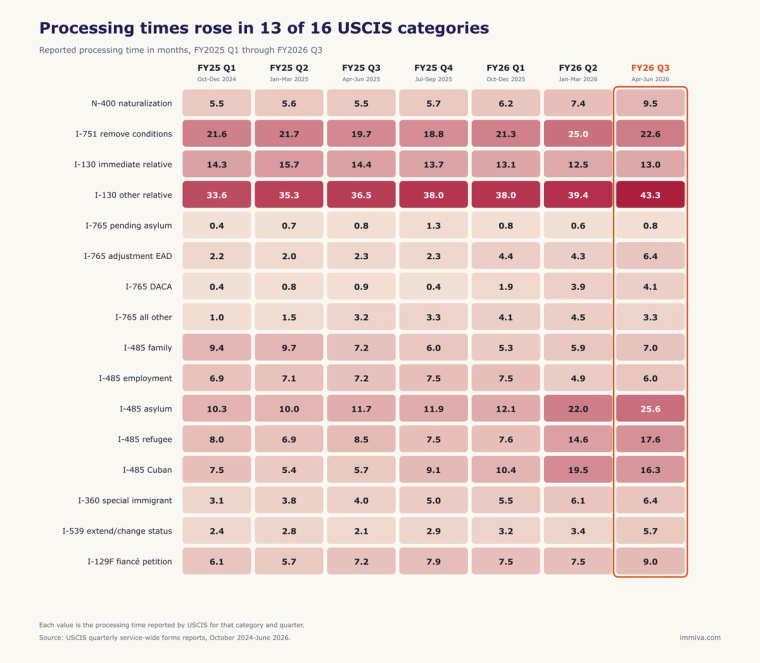
Quarterly processing times for 16 USCIS form categories from FY2025 Q1 through FY2026 Q3.
N-400 naturalization rose from 5.5 months in FY2025 Q1 to 9.5 months in FY2026 Q3. Over the same period, completed cases fell from 218,891 to 67,565. Pending applications increased from 524,675 to 727,371, and net backlog grew from 75,600 to 473,700.
Processing times and pending counts also rose in two nonimmigrant petition categories. I-539 processing time increased from 2.4 to 5.7 months, while pending cases rose from 69,780 to 133,056. I-129F fiancé petitions went from 6.1 to 9.0 months, and pending petitions rose from 28,839 to 35,871.
Our N-400 processing-time guide covers the naturalization timeline in more detail. Applicants can also use the guide to checking N-400 case status.
I-751 stayed slow while completions fell
I-751 processing time was 21.6 months in FY2025 Q1 and 22.6 months in FY2026 Q3. It reached 25.0 months in FY2026 Q2 before falling in the latest quarter.
Workload figures changed more sharply than the reported time. Quarterly completions fell from 28,912 to 10,994. Pending petitions increased from 217,204 to 339,830, and net backlog grew from 167,400 to 244,100.
Net backlog fell as a share of pending inventory, from 77.1% to 71.8%, because total pending cases grew faster than the rounded net-backlog count. The queue still grew: USCIS ended FY2026 Q3 with 76,700 more net-backlogged I-751 petitions than it had at the end of FY2025 Q1.
The I-751 processing-time guide covers extension notices, travel, work authorization, and what to expect while a petition remains pending.
I-765 processing times split by category
A single I-765 average hides four different quarterly trends. In its service-wide report, USCIS separates work permits into pending-asylum, adjustment-of-status, DACA, and all-other categories.
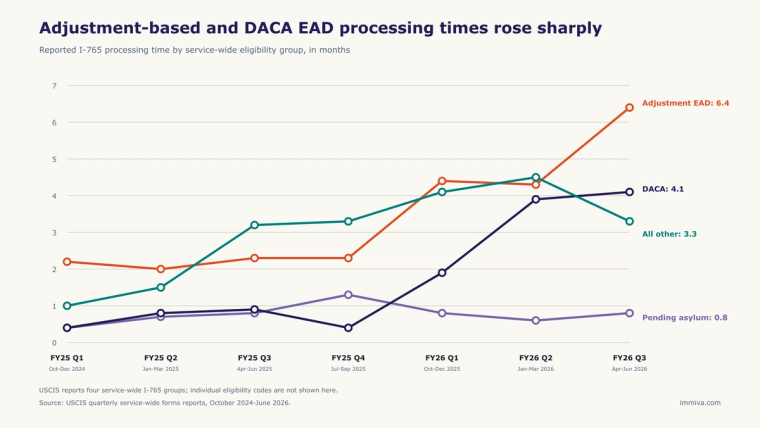
Quarterly I-765 processing times for pending-asylum, adjustment, DACA, and all-other categories.
Adjustment-based EAD processing time rose from 2.2 to 6.4 months. Pending applications increased from 154,469 to 671,362, and net backlog reached 502,000 in FY2026 Q3.
DACA EAD processing time rose from 0.4 to 4.1 months. The all-other group went from 1.0 to 3.3 months after reaching 4.5 months in FY2026 Q2. Pending-asylum EAD processing time increased from 0.4 to 0.8 months, while its pending inventory fell from 293,131 to 108,565.
These four service-wide groups are broader than the individual eligibility codes used on Form I-765. For help planning within a specific category, see our guides to H-4 EAD processing time, J-2 EAD processing time, and why filing an EAD renewal early matters.
I-130 moved in two directions
An average for all I-130 petitions obscures a large difference between the two categories.
Immediate-relative I-130 processing time fell from 14.3 to 13.0 months. Pending petitions also fell, from 852,120 to 786,723. Net backlog, however, rose from 522,400 to 572,300, increasing from 61.3% to 72.7% of pending inventory.
Other-relative I-130 processing time rose every quarter, from 33.6 months in FY2025 Q1 to 43.3 months in FY2026 Q3. Pending petitions increased from 1.45 million to 1.62 million. USCIS reported a net backlog of 123,500 for this category in the latest quarter.
The I-130 processing-time guide explains why the relationship category and visa availability change what happens after USCIS approves a petition.
A lower I-485 time did not always mean a healthier queue
Family-based I-485 processing time fell from 9.4 to 7.0 months. Employment-based I-485 fell from 6.9 to 6.0 months. Neither category reduced its pending inventory or net backlog.
Family-based pending cases rose from 548,621 to 611,067, while net backlog grew from 318,000 to 426,800. Employment-based pending cases increased from 181,732 to 268,408, while net backlog rose from 54,600 to 88,600.
Processing times rose across the humanitarian I-485 categories. Asylum-based processing time went from 10.3 to 25.6 months. Refugee-based processing time increased from 8.0 to 17.6 months, and Cuban-adjustment processing time rose from 7.5 to 16.3 months.
USCIS also completed far fewer cases in those categories. Refugee-based completions fell from 17,756 to 148. Cuban-adjustment completions fell from 27,602 to 586, and asylum-based completions fell from 29,089 to 2,642. A processing-time figure based on so few completions needs extra caution.
Our I-485 processing-time guide covers the adjustment process and the limits of published averages.
Processing time and backlog can move apart
The two-panel comparison shows the limits of using a processing-time number on its own: three categories had shorter times while net backlog grew as a share of pending inventory.
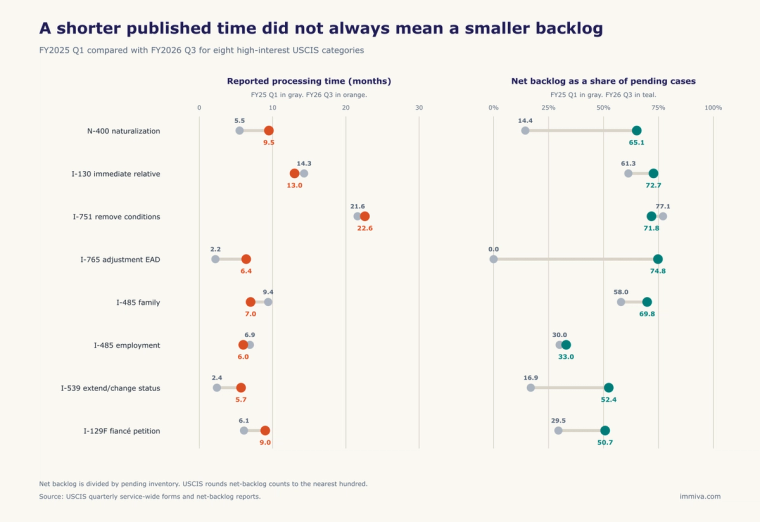
Processing-time and net-backlog-share changes for eight USCIS form categories between FY2025 Q1 and FY2026 Q3.
For immediate-relative I-130, the reported time fell by 1.3 months while the net-backlog share rose by 11.4 percentage points. Family-based I-485 time fell by 2.4 months while the share rose by 11.8 points. Employment-based I-485 time fell by 0.9 months while the share rose by 3.0 points.
These movements do not make the published processing times wrong; the measures describe different groups of cases. Processing times measure completed cases. Net backlog measures cases still waiting beyond acceptable pending, after USCIS removes customer-caused delays and visa-unavailable cases. The groups leaving the system can differ from those still waiting.
How to use these numbers
Use quarterly processing time as a planning reference. It describes cases USCIS completed during a period; it does not predict your case's timeline, account for its filing date, or set a deadline by which USCIS must decide it.
Check the category as well as the form number. I-130, I-765, and I-485 each contain groups with very different results, so the row that matches your filing basis can be more useful than a combined number.
Read pending inventory and backlog alongside processing time. A shorter reported time can coexist with a larger queue. If a category has very few completions, treat a sharp change with caution.
Immiva prepares and checks N-400, I-751, I-130, and I-485 filings, plus H-4 and J-2 work permits. The software validates answers, flags missing information, and reviews the packet before download. Immiva is not a law firm and does not provide legal advice or representation.
The short version
Quarterly USCIS data shows that processing times rose in 14 of 17 reviewed categories from FY2025 Q1 to FY2026 Q3. N-400 increased from 5.5 to 9.5 months. I-751 remained above 20 months, and adjustment-based I-765 rose from 2.2 to 6.4 months.
The results depend on the category: immediate-relative I-130 improved while other-relative I-130 reached 43.3 months. Family-based and employment-based I-485 had shorter processing times, but both had more pending cases and larger net backlogs. Processing time describes completed cases; it does not describe the entire queue or predict an individual result.